The morning of Trump’s victory a man in a newsagent said that I should be the next Prime Minister. What did I do to merit consideration for the highest office in the country? Told the man serving me that Trump and Clinton were not equally bad; called Trump dangerous and pointed out that those Americans voting for him because he wasn’t part of the political establishment probably wouldn’t accept the services of an unqualified, anti-establishment brain surgeon. Volià – it seems that with a few catchy opinions (and a cool billion to spare) you’re half-way there. It worked for Donald.
Deer in headlights, petrified. A justifiable response to Trump’s election.
Of course it was a joke; who knows ‘you’re fit for the premiership love,’ might become another way middle-aged men chat up women young enough to be their daughter. It was also unfortunately no joke that Trump had actually won. But this little charade in the newsagent and a tweet that appeared on my feed, saying that the best way to fight Trump was to stand up for the rights and values he opposes, made me feel a little less hopeless about the whole situation- a little less like I was watching the brutal abduction scene in Nocturnal Animals and powerless to stop it. I thought if we’re still here and breathing there must be something we can do turn the tide. So I came up with a list, a starting-point for fighting Trump & Co and their venomous xenophobic, sexist, racist, homophobic, climate-change-denying ideas:
Accept that these right wing demagogues have gained traction due to inequality of income and opportunity as well as pure hatred. We can’t go back to what was; we can only go forward from what is.
Cultivate a diverse network of friends and acquaintances – don’t just talk to middle class, highly educated people of your own age. Do we need any more evidence that preaching to the converted doesn’t work? Social division creates a vacuum for Trump & Co to spread their messages of fear and hatred.
Speak up against injustice – Catherine Mayer co-founder of the Women’s Equality Party put it best: ‘Here’s how to respond to Trump. Do something today to fight for the rights & values he opposes. Then do something tomorrow and the next day.’
Speak another language – There’s no better way to defy the nationalist demagogues who say: ‘Speak English, revere our dominant national symbols or get back on the boat.’ (Never mind that a unified culture doesn’t exist within the Anglophone community itself). So give the international finger to monocultural propaganda by flaunting your new-found ability to order polski piwo, gossip in Spanish or pronounce Baile an Bhuinneanáigh like you’re from there.
Hug a tree – metaphorically, because if you deny climate change… well you’re starting to resemble Trump & Co already. And literally throw your arms around your tall, mossy friend because they have been here, on this one earth we share, longer than any of us. They’ve survived the cholera and Hitler years, they’ll survive Trump & Co and forever be an international symbol of grace, vivacity and hope.
‘I hope there are theatres wherever she goes on to,’ I wrote, when I learned that my mum’s elderly neighbour had died. The afterlife would be no heaven for Pat if it was a mere resting place, devoid of art, entertainment and gossip.* I don’t know everything about Pat, but I remember this: as a young woman she got into RADA (Royal Academy Of Dramatic Art) and her father forbade her from attending. Something about actresses not being entirely respectable. It was probably the late 1950s or early 60s, when Dames Judy (Dench) and Vanessa (Redgrave) were beginning to hit their stride, an untimely period to squander this opportunity to fear and small-mindedness. Who knows what would have happened if Pat had been allowed to take her place? Her talents might have made her another Dame of the Realm; she could have joined a low-budget travelling theatre group and slept on cold creaky floors all around the country; or jacked it all in to marry the first Stage Door hound who asked. She might have been happier or less so, or both at different times. I wonder what her ghost will do, if it has a choice.
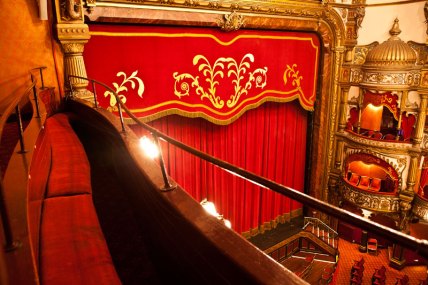
A view from the gods, where we’re all headed.
Careers are born when talent meets opportunity. In my view, talent always meets with opportunity; it just might not be the one you anticipated. In the arts, opportunities are rarely tailored to individuals as snugly as Cinderella’s slipper matches her foot. Most art practitioners, curators and academics are clomping around in odd-fitting roles. Sometimes you can feel too big for the tiny, Miss-Havisham-sized boots that have been assigned to you. You’re boxed in, blistered and unable to grow. At other times, your little feet might be pacing through a multitasking army of boots that would better suit a human centipede. Given the grail-like scarcity of a fulfilling, decent-paying role, square pegs are filing down their idiosyncratically calloused edges to fit the prescribed round hole. There’s this sense that steady, even career progression doesn’t exist- you have to acquire training and experience, promote your work and then the rest is down to canniness and fortune. It’s a wonder arts professionals don’t go about with a string of good-luck charms.
Sometimes other people’s filthy shoes are found eloquent as they are – without you having to touch them.
There are a disproportionate number of stories about people risking everything for love, but in my lifetime, I’ve seen people do bolder and madder things for art. Here is a select list of impassioned acts: working four days a week, full-time, unpaid, to gain experience, at the same time as finishing a masters (that was me); leaving your well-paid, secure job to make or research something with erratic returns; moving an ocean and maybe a few continents away from everything you know to pursue training and opportunities which will leave you with unfathomable levels of debt; making a criminally low salary s-t-r-e-t-c-h to cover rent, living expenses and the occasional perk in one of the most expensive cities in the world; saving money and gaining bohemian kudos by staying in the same room as a couple, separated from them by a partition so thin, you can tell they’re not having relations; holding out for that one perfect job in your industry, though someone might have to retire or die for you to get it; setting yourself the task of completing something nearly impossible, whether it be a theoretically nuanced survey of Tudor brooms or an initiative to revive the cod-piece for a new generation.
Frugal Glamour tip No.1: Wear a fungal fur hat to endure the cold in the (free) reading room at the British Library this winter.
The subsistence theme crops up in almost every example, because most arts practitioners feel that at least half their creative energy goes into making ends meet. In fact, the stories of how people stay afloat whilst serving the Muse, are often more engrossing than the art itself. How much are people willing to yield to sometimes nonsensical conditions to further their goal? Everyone comes to know their limits. I soon learned that working unpaid for other people doesn’t agree with me. Apparently it’s meant to make you feel beatific with self-sacrifice and gratitude. It never worked out that way for me. Instead, it made me broke, anxious and gluten-intolerant. The latter was especially cruel, because bread and pasta cost less than the lentils and nuts I had to replace them with. (FYI, I was able to eat toast again as soon as the exploitation stopped). But the worst symptom of all, was that a previous delight had become a burden, a guilty excuse for not finding a decently-paying job that served society more transparently.
Some years later, I’m serving a different muse, more a Calliope (epic poetry) than a Clio (history), and have taken earning into my own hands. To the great shock of some employers, I insist on knowing (and sometimes naming) my salary out-right. It can be tight and my tax return, which has to account for so many different income streams, is an epic to work through in itself. But, it’s a path I’ve wanted and was free to choose, where Pat wasn’t.
Because passion for one’s vocation and ahem, ‘curiosity’ about one’s salary are mutually exclusive… Not even sandals in winter will fool the Muse.
*As a teenager, I remember my friend saying that she thought heaven wouldn’t be the generic glowing place but the deceased’s personal idea of bliss. For both of us, that was New York, a city we’d never visited, but had been sold to us through sitcoms, Alicia Keys and advertising. To this day, each time I take my first steps in New York after a hell journey, I float in a jet-lagged haze, where everything, from the fire-escapes to the drains is tinged with wonder. I feel an almost divine rush of energy from my feet to the crown of my head, like I’m priming myself for miracles. And each time I leave, I get depressed because it’s an expulsion from Paradise.
The tipping point is the moment from which nothing anyone could say will interest you. I’ve combined the conditional and future tenses intentionally, because I mean nothing in the whole possibility of things to be said (conditional) will be of any interest from this moment on (future). You’re at an event and your social switch has suddenly flipped to the ‘off’ setting; perhaps you’ve have a concentrated mingling period and your sanity demands that you hermit away for a week; or perhaps, like me, you’re uncomfortable with formality and prefer socialising like a twelve year-old, in pairs and threes.
Dipping, tipping, (toppled)…
As a fidgety introvert, I like immersive environments that allow me to focus my energy and attention. I’ve enjoyed the following: intense one-on-one discussions; being a bridesmaid in a best friend’s highly choreographed wedding and attending a two-day birthday party with activities and escape nooks as well as boozy chatter. Over the years, I’ve engineered my life so that it includes a fair amount of zany, whimsical dos and a minimum of the formal drinks, barbecues and dinner parties whose lifeblood is appearances and group conversation. What turns me off these events is small talk, constrained spaces and dress codes that usually force me to be colder than I’d like. Moreover, I’m prejudiced that in these situations people are stuck in a muted midpoint between the personal and professional, but reaching the fascination of neither.
My new boyfriend however, takes a different view. He sees formal occasions as an opportunity to wear your nice shoes, catch up with old acquaintances and meet people you otherwise wouldn’t. He’s genuinely interested in what people do, where they’re from and what they think about foreign policy; whereas I gravitate towards their silliness and their soul. I usually arrive and leave in the middle; he jokes that he’s got a reputation for being the first to arrive and the last to leave, and by the way, would I like to go to a party or two with him?
When I see civilised-looking strangers standing around with drinks, talking politely, I’ve already reached my tipping point, though we’ve just arrived. Conversations are hard to follow and words coming from people’s mouths vie for my attention with song lyrics, background chatter, overpowering aftershave, the glare from the sequins on someone’s dress and the slightly off taste of Country White. Someone tells me where they live and I instantly forget; I have no opinions or knowledge of Thailand’s economic policy, or even anything related; I’m bored replying to a question on what I do, and get distracted by a ladybird crawling on a fence. I’m squeezed by the competing sensations that there’s an awful lot to take in and absolutely nothing to do. I begin to long for a book to read or colour. I’m not even joking.
When your shoes hurt, you’re depressed-drunk and generally not in the mood…
Afterwards, barely having scraped through, with my dubiously stained slip dress and ready death-stare, I think back to the wished for colouring book. I interpret it as the desire to solve this problem creatively. What I need to do, is keep myself interested so I don’t zone out, and simultaneously, stop myself from getting overwhelmed. By this point, the socially-adjusted reader will think that I’m developmentally challenged; other emotionally-motivated socialisers however, might recognise some of my anxieties. This list of mood-altering suggestions is for them:
Preparation : The Debutante Nap vs Running on Adrenaline If you’re sure that the tricky event will be blessedly short (under three hours) you might consider racing into it from an action-packed day, so you don’t have to think too much. However, if said ordeal is likely to last more than three hours, take a nap if you can, or do your choice of endorphin-boosting activity beforehand.
Catch the most interesting talk Once you’re there, remember that you’re mobile and not glued to your partner’s side or to the poor sod who insists on a detailed explanation of your third PhD chapter. Find the conversation that most piques your fancy, then pay attention and ask about the things you genuinely want to know. Hopefully they’ll do the same and who knows, you might enjoy yourself. Some people advise playing the ‘relatables’ game, i.e.: no, you don’t have a mortgage, but your best friend says getting one is bloody hard etc… I think this is a slippery slope unless it’s a topic you actually want to talk about. If you’re not interested it will show in the dead goldfish expression on your face.
Throw a ring round that conversation like it’s a much coveted Pokémon!
Be inspired by a recent Chinese immigrant Neville*,who is only on his second month in this country, set a shining example of how to socialise. Naturally serious and mellow, he was obviously at ease in his own skin. He talked about things that interested him, responded observantly and casually looked at his phone when the conversation turned to British school boards. I noticed how despite Neville’s lapse in concentration, he remained part of the group – his feet were pointed towards us and his body language was relaxed.
When you meet the worst person in the world Stuart was busy showing off a camera app on his phone that didn’t only let him monitor his son, but his son’s babysitter and even his wife, so that she wouldn’t go out and shop too much. I would have disliked Stuart under any circumstances, but at a party he wears right into my already short social fuse. My death stare won’t actually kill him, or convert him into a reasonable sort of man, but it will make everyone around me feel awkward. What I can do instead, is try to see Stuart for the hilarious specimen that he is. He is clearly compensating for something. I visualise that he has a petite prick and feel better already. If I’m in a gutsier mood, I might challenge him on the finer points of his spying system: does it cover the toilets as well?; is it in any way democratic? Most importantly, I need to keep Stuart in perspective. He is a single blight on humanity. If I leave because of him, then I make him as important as he wants to be. On the other hand, 3 Stuarts and I’m out!
Drink if you can get away with it and it’s your thing The green fairy (absinthe) and her descendants make everything flow much more smoothly. Some people would put this at number one.
Find on-site distractions when you need a break from the monotony of constant talk. Not everyone is a conversational marathon-runner. Offer to help with serving or setting things up. Playing with children and animals can also give you a breather, ditto pool tables and card games.
Take a luxury break When you’ve reached your tipping point prematurely and it’s beyond the first hour, say you have to make a phone-call, yes even on a Sunday (your boss doesn’t know the meaning of a day off) and take a walk. Make this break, all twenty minutes of it, as voluptuous as possible. Go where you’re out of sight and read a chapter of your novel, instagram a few porches or look in the local antique shops. Try not to come back with an entire dining table. You’ll be the re-born phoenix of the party. I reckon you can get away with this twice in a single event.
And when you’ve really had enough, the party’s moved location three times and the crowd has started thinning, it’s time to go. After all, no-one should overstay their welcome.
Savage Fighter has no spare time. Or hobbies. He instinctively sidelines anyone you introduce him to. He has a mouthful of yellow incisors and never misses an opportunity to beat up his enemies. Savage Fighter might sound a bit like the worst boyfriend you’ve ever had, but he’s actually a character in a story by my nine-year-old tutee Joseph.* Savage Fighter was born a child of Sparta for two reasons: 1) When I met him, Joseph didn’t like to write very much ( SF’s lack of characteristics meant he could written up faster) 2) When Joseph did write, it was always about warrior heroes- bloody conflicts, earthly or celestial, fascinated him and redeemed the process of writing. You might be surprised to learn that Joseph is also a kindhearted cat-lover, who recently wrote about a lego utopia, where no one ever dies.
A lot of people attribute the resistance boys like Joseph have to writing, to their maleness. ‘Like all boys he can’t be bothered… Boys aren’t very creative…’ are things I’ve heard from parents and friends alike. With a growing roster of male tutees, all of whom had difficulties in writing, I might have believed it. But I couldn’t quite square it with four years study of mainly male authors during my English Literature degree; or with how books by male authors are still taken more seriously, to the extent that in 1996 Bailey’s took a break from perfecting the churn of fermented Irish cream, to introduce a prize for women’s fiction. Does all this mean that there are two types of man: the kind who can write, the literary genius entitled to immortality and earthly perks (a writer friend thought he did better on Tinder because he could deliver more than ‘wow ur fit, fancy a drnk?’ ) and the strong, silent man of action/ mathematical formulae?
I also couldn’t square these stereotypes with my experiences as a tutor. Each boy, at this age of 9 or 10, when they can be lumped together in one conglomerate category, is different. Some write riotously fast with an ear for comic detail. They just want to communicate their ideas and aren’t too fussed about what Flaubert termed le mot juste. Others deliberate over everything they write and are as eager for new words and sentence structures as a Michelen-starred chef is for nuances to their method. The overriding similarity is a preference for adventure stories with almost nonsensically complicated plots and varying degrees of bloodshed. When a boy is overly obsessed with shoot-outs, with describing the exact dance of bullets though a torso, we negotiate a sort of Arms Treatise, whereby we agree that only a small proportion of stories can feature brains being blown out by AK47s. Though it’s not my main role, I feel like I have some responsibility, as an accomplice to these boys’ visions of life in writing, to show them that gun-crime isn’t a joke and that narratives can be just as exciting when they’re not littered with corpses.
Violent or otherwise, their fictional worlds are resolutely male, with a protagonist who they identify with, and the male sidekicks, superiors and enemies he interacts with. Mothers appear fleetingly, as did one obese neighbour called Sally. Girls aren’t that interesting yet, (and you wouldn’t want to force them into someone’s latency period), but do they have to be banished entirely from the fictional worlds of adventure? Should I intervene? This is fiction, after all; in reality, they treat me and every other woman they speak of with respect. And yet, I don’t think it will harm them to imagine more inclusive scenarios…
As I teach, I find that I’m also thinking more about the process of writing and the problems that crop up, whatever your level. Here are three simple observations:
Environmental factors creep in and shift things around. ‘I think I made it rain because it started outside,’ one boy explained.
Everyday actions get in the way of/make a good story. Together we debate when to reel out the detail and when to cut to the next scene. It’s a question of tone and pacing. We really don’t need to know that your characters brushed their teeth before bed every night; but if you don’t make unlocking the treasure chest last for at least two sentences, the discovery will be anticlimactic.
It’s pretty difficult to write about someone’s eyes in an unromantic way. I kept this observation to myself while my tutee, Oliver, churned out 5 variations of his story’s opening line. The story began with a dream of President Obama letting him know with one look that he was about to be entrusted with a special task. Oliver’s variations included: ‘President Obama gazed at me with his cloudy brown eyes’/ ‘looked at me with his warm brown eyes’/ ‘stared at me with his intense brown eyes’ and so on. Although Oliver had been encouraged to write as descriptively as possible at school, using ‘strong adjectives’ and ‘powerful verbs,’ I was half concerned that when his mother saw the sentences she’d think I was engaging him in a Mills & Boon assignment for my own satisfaction. Then I thought that unless you’re giving a deliberately unflattering account, your writing on eyes automatically gains an erotic charge, because it shows that you’ve been looking enough to notice their colour, size, shape and expression and you’ve carried this memory through time. This may or may not have been your original intention.
Over time, I feel my own taste for language changing. As I encourage my tutees to use more sophisticated language, I’m learning to appreciate simpler, more spontaneous turns of phrase. Those staples of arts academia, long latinate words like problematise (which should be banned because it sounds ugly), destabilise, amanuensis , deconstruct and fashioning, make me grimace whenever I hear them. Spoken within too close a range of each other, or too often, they feel pompous and long-winded. They can take you so far from what you actually mean; you can lose yourself in them. My tutees would simply say that you’re trying to sound ‘clever and posh’ by using long words. It’s not that I want to go back to being ten, unlearn everything, but I do want to write in a way that’s more authentic, less studied. The irony is, I’m studying anyway, filling whole notebook margins with passing snippets of so-called common parlance.
If you were deported, or less harshly, voluntarily expatriated, what would you need to feel at home in your new place? Would you embrace the differences or create the same kind of home anywhere?
These questions entered my head as I travelled through several homes in the past month and a half with my blue wheelie suitcase in hand: my childhood home; an AirBnB just outside Cambridge Massachusetts; a room in a family home in more rural MA; an air-mattress in a Lower East Side apartment and let’s not forget the night at the Blue Moon. Each location was different, and yet all came to resemble one another through my habits and chosen town haunts.
Could be anywhere… could be Massachusetts
When I arrived at my AirBnB in Cambridge in the middle of a rainy afternoon, jet-lagged and with zero phone charge, it felt completely unfamiliar. The red velvet cushions, bronze ornaments, turquoise printed wallpaper and delicate tulip-patterned crockery, made me feel like I had just stepped out of the book I was reading, Ohran Pamuk’s The Museum of Innocence. As though like Columbus, I had travelled in the wrong direction and ended up finding… the East. The neon signs on the local convenience store assured me I was in America; though the only appetising thing they sold was tabouleh…
The next day, before I found my workplace for the month, or even the internet, I found Karma Yoga Studio. I stepped in, thinking it would be nice to keep up my old hobby, and instantly made a habit of attending Karma’s (yes a Karma within a Karma) flow and restore classes on Monday and Wednesday evenings. The poses were slightly different, as were the names. Dragons, monkeys and dolphins expanded the menagerie beyond the domestic dog kennel. I could breathe more deeply and was more flexible, but had less balance. Still, I felt some continuity in the movement, something like home. They say home is where the heart is, and as I move, my heart is above my feet.
I wonder if it’s an option to not be at home in the place you travel to. To be like Odysseyus, stay as a tourist, taking in strange sights and cuisines, while having a firm idea of your origin as home. But if you’re elsewhere for a month, could you in your heart of hearts stay faithful to your home as you remember it? If you like drinking guinness in Irish pubs, wouldn’t you find a new local? Irish pub landlords all over the world rely upon your infidelity to home, and paradoxically, also upon your innate sense of home. I’m a fan of Irish pubs because they’re a friend to the small-bladdered as well as to those who like getting bladdered. Wherever you find an Irish pub, they’ll let you pee for free.
1369 degrees of welcome
If you move somewhere for any length of time, I’d say over a week or so, you’ll start to have favourites and orient your life around these points. While I was in Cambridge, I accumulated the following:
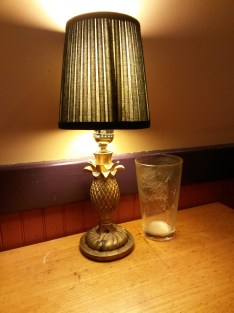
A FAVOURITE CAFE: 1369 on Massachusetts Avenue. Favourite Seat: The high table with the pineapple lamp. I once heard that in the days of expeditions, returning sailors would place a pineapple in their doorway to let the townsfolk know they had returned. I’ve been drawn to them ever since.
A LITTLE JAPAN: Theolonious Monkfish also on Mass Ave. Japan is the most enchanting place I have ever visited and I look for reminders of it everywhere I go. Here they play live jazz and serve sushi as they do in Murakami novels and Japan proper. The sushi rolls, called Snow White, Sleeping Beauty and Rumpelstitskin though, are strictly Disney.
A LITTLE PARIS: I found Paris twice through the Landmark cinema’s weekly emissions. In Paris almost every cinema will show pictures of the city; in London too, there is always a choice of French films; but at the Landmark, there was only one at a time, so the views stretched before me in celluloid, felt like love-letters from the old world to the new.
A LIBRARY LIVING SPACE: Lamont Library, Harvard University. I like places where books are abundant and un-sacred. Where you can enjoy them with a tea, a box of paints or from a high vista wearing sunglasses. This is such a place, as are the Central Saint Martins and Senate House Libraries in London and the Bryant Park, Open-Air Library in New York City.
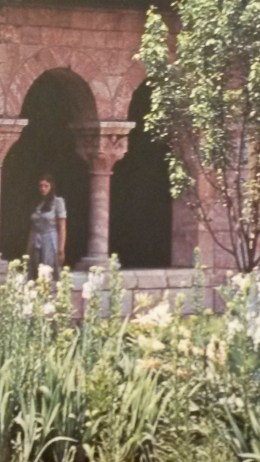
From the old world to the new, The Cloisters, 1978
I arrived in Cambridge, knowing no-one, and everyone I met, whether friends of friends or random encounters, had washed up there through the job or spouse lottery, some more happily than others. They all spoke of the town as a place they hadn’t chosen for themselves; it fitted like an odd shoe. Too provincial or too Yanky; too cold but a lucky escape from Trump heartland… The place had a charm though, they admitted, once they’d found their favourite spots and began living through them.
One Friday, it was unofficially Expats night at Cafe 1369 – a refuge for the friendly friendless, amorous opportunists or anyone who wanted to be alone together. I sat by my favourite pineapple lamp and took out a book of Emerson’s essays, trying to read, trying not to listen to the Beach Boys. Soon, I found myself talking to two MIT (Massachusetts Institute of Technology) scientists: one from Iran, the other from more prosaic Guildford, a town near where I grew up. These guys had essentially followed their research to wherever opportunities presented themselves; however far from home. If Princeton gives you a PhD scholarship, there you’ll go: though you might miss your parents and brother, not see them for whole stretches of time; though you don’t actually go to New York that often and spend most of the time out to pasture with your equations in a nice deer park; though you meet so few girls that you ask whether ‘Are you allergic to rabbits?’ is a viable chat-up line. Then, when the post-doc comes up at MIT, you can’t refuse: it’s not like there are that many jobs in this trade (wave-modelling) anyway. Waves, I found out, can be modelled directly from your laptop. But if you want to model them exquisitely, you kinda need to be in one of a handful of specialist labs, which could be anywhere and you have to be prepared to transfer between them if you’re going to be funded for your next project.
While Cambridge is lovely, it’s where these guys have chosen for their career and not for their whole selves. So it only stays half a home to them: another part of them misses where they came from; another still wonders about somewhere else entirely. When my work there is done, I too leave Cambridge half the way to creating a home. And then I get swept back into my real life in London. Some weeks later, it’s oddly vivid and unreal, like a distant experiment in living…
The island of utopia, a rabbit’s tail, a minimalist sneeze in a foreign museum …
Writers’ retreats are as wanky as they come, but necessary when you’re writing a book. They furnish inspiration at the beginning and filter out everyday distractions when you’re trying to finish. There are the formal ones that take you to the countryside haunts of Writers Of The Past for quite a fee. It is always the countryside, because the retreat-goers want some level of escapism, and a bucolic manor does this better for most people than a post-industrial wasteland. I’ve only gotten to the ‘scanning the brochure’ stage of these retreats, so really can’t comment on what goes on there…
Not the official writers’ retreat brochure, but equally picturesque, no?
Here are some nice alternative retreats I’ve heard of. No.1: THE CHILDHOOD FAMILY HOME. A friend who lives somewhere so remote and picturesque that I’m surprised that she hasn’t figured out that she can set up her own Writers’ Retreat and charge £700+ per week, goes back to stay with her family in a slightly less picturesque place when she wants to make serious progress with her book, because they are the funniest human beings alive. They feed directly into the book’s dialogue and amp up its mood. I imagine that another perk of this retreat, is that it provides free food and shelter…
No.2: THE EXOTIC. Another friend has quit her job and is moving to Bali for three months to finish the novel she’s had on her heart for six years. Bali! There will be chilled sunbathing, yoga and cafes by day, and furious writing by night. She’s been there before and says the energy is supportive for writing. Board and food are not free, but they are a lot cheaper than London. So, if you can get enough money for the plane ticket…
And mine? Let’s call it MY MOVEABLE FEAST. Yes, like so many other writers I went to Paris. I went there because it was easy to get to and I have somewhere free to stay, but also because I wanted to feel like I was writing the width of my book as well as the length of its plot. The clichés are right, Paris is one of the best places to observe life and jump into it. Apart from its beauty, the city’s social dynamic catches my eye straight away. People notice each other. They look, feel and register each others’ presence far more openly than in London. I remember this man’s shudder in the Metro when two women strode past him in clippety cloppety heels. It was as though he felt them walk right through him. Then there is how the waiter just knows to duplicate someone’s order when their companion arrives; the huddling of fur coats in the sudden giboulées de mars (a kind of snow-sleet, which returns to Paris every March)
How could something not happen here?
I also went to do some location research for my novel. Some places left me dry, but in others I experienced this strange kind of synchronicity, where I felt like the novel was unfolding around me. Before coming to Paris, I had envisaged a scene where a character gets the fright of her life in a graveyard. This idea was on probation- I could discard it at any moment for being too predictable and unconvincing. Anyway, I figured out that I had had half an hour before meeting a friend for brunch, so I would go and visit the nearby Montmartre cemetery to test the water.
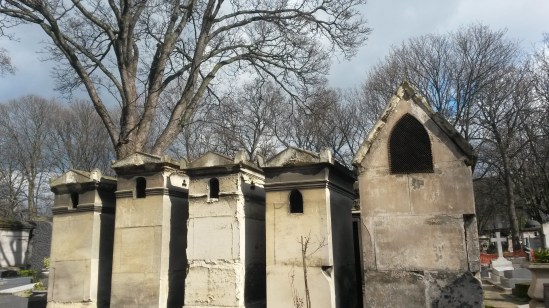
Passing by the tawdry wide front of the Moulin Rouge, the black and red sex shops and the funerary outfitters selling wax flowers, grecian urns and statues, I approached the cemetery casually, like it was another thing to look at. And then I saw that some of the graves had been moved beyond the cemetery gates, underneath an overpass, where vehicles thunder past constantly and there is a thick smell of gasoline. In case you’re interested, the graves were moved to this damned spot to fulfil Haussman’s stringent city plan in the late nineteenth century. These people’s families had built them elaborate marble fortresses to give them protection and standing in death, and now here they were, like vagrants under a bridge. I didn’t know what was worse, that these bodies had been moved, or that the families had put so much energy into trying to immortalise their dead, as though to deny the inevitable.
Imagine crossing a cemetery and a grand bourgeois street under a bridge…
Inside the cemetery, I felt even more unnerved, seeing that the headstones faced in all directions, and some of the death fortresses’ glass vitrines had fist-shaped cracks in them. A crow in a tree behind me made a choking sound; a wasp buzzed right past my ear, causing it to ring for a good five minutes, and giant cobblestones threatened to trip me up at any time. The place had so unhinged me that when a young girl in spectacles whizzed down the middle bannister of the stairs separating the higher and lower parts of the cemetery, I briefly entertained the idea that I had seen a witch of the storybook variety. I had gone into this place to pull the cheap parlour trick of a character who gets the fright of her life, and in a rare post-modern moment, I had gotten the fright of mine.
It may be expected that after this experience I wasn’t able to eat a bite at brunch- but no, I was starving and went at it like a Brit who’s paid and is getting her money’s worth. That night in bed though, I couldn’t get the cemetery out of my mind. Images from the day kept flashing back. I panicked about the unhappy ghosts wreaking their revenge because I was exploiting them for creative profit; pondered upon a friend’s comment that girls like me were the most susceptible to being spirited away in graveyards, and feared that I would develop post-traumatic stress disorder and never be able to erase the images from my mind.
Imagine this, circled by crows, grown fat with God Knows What, and you have it…
When trying to force myself calm didn’t work, I tried a counter-scare tactic. I should be more frightened of terrorists than ghosts, I told myself. A Londoner who hasn’t had a major terrorist attack in her city in the past two years, might think that terrorists are more of a real threat in Paris. Terrorists can’t walk through walls though, my subconscious answered back. They can’t just linger, like ghosts can.
This wasn’t to say that I wasn’t conscious of the possibility of an attack. It was unlikely, but you just had to be in the wrong place at the wrong time. I have to admit, I did try to second-guess the terrorists a little: judging by their previous record BD (comic-book) shops and anywhere hipster could be more risky, while the exhibition of gowns worn by Proust’s muse at the Musée Galliera in the chi-chi 16th district, was probably too obscurely girly to be on their radar.
I also instinctively searched for signs of terror in people’s faces and in the streets. Place de la République near where the attacks had happened was alive with breakdancers, lion statues daubed in bright graffiti and colourful poems, candles and bouquets for the terror victims; but Canal Saint Martin seemed a little deserted and sad for a Saturday. This may have been have been more due to the ferocity of the giboulées than the terrorists, though. A Parisian friend told me that the first weeks after the attacks, everyone was looking at each other suspiciously on the metro. By now, things were getting back to normal. Life goes on.
I realise that I’ve become distracted from the retreat theme in the process of writing. But maybe that’s what retreats are meant to be; a place where ideas can magically sweep together like pins to a magnet, but also somewhere where new yarns begin. Another labyrinth for Ariadne…
A Montmartre cinema disappearing into a cloudy sky…
I’ve had a golden book under my wing for the past week, Amy Cuddy’s Presence: Bringing Your Boldest Self to Life’s Biggest Challenges. It’s golden in at least three ways: in colour; in its sunny, empowering message, and in drawing attention to its reader. Whenever I’ve been with the book in public, I’ve been approached by strangers who want to talk about presence: what it means in this age of constant distractions; can we ever achieve it totally?; and is it even desirable?
Cuddy defines presence as authenticity manifested through the body. When you’re present your intention, vocal range and body language are all synchronised and you are the most powerful and compelling version of yourself for that moment in time. Presence isn’t a permanent or inevitable state, but one you can key yourself into through certain physical cues. It’s about taking up your fair share of space rather than shrinking, and also, interestingly, about taking up your fair share of time when you’re speaking or making decisions. Cuddy observes that a lack of confidence doesn’t just make us hunch and avoid eye contact, but we might rush our words or hurry an important decision for fear of taking too much of others’ time.
I definitely experience presence as mutable. It’s both connected to my mood and a tool-kit of tricks that I can mobilise for an instant dash of courage. On good days I instinctively stand tall, intuiting my yoga teacher’s advice to keep the back of my neck long and expand my vision. I love this posture because it means I can actually see more, gain perspective and connect better with what’s around me. Then, there is Wonder Woman pose- hands on hips, feet apart – which is a life-saver before difficult conversations or walking past a band of leery dudes on Regents Canal. There’s something about this simple pose that makes me feel solid and puts me in touch with what power I have.
Where I really struggle to be present, though, is in goodbyes. Even in everyday partings from people I see habitually, I find it difficult to maintain eye contact and keep my voice from dropping into my shoes as I turn away. I wonder sometimes, if part of me doesn’t quite believe I’ll ever see them again and that I’m somehow protecting myself by not being fully present at the moment of goodbye. Sometimes, I’m so absent when I say goodbye, that the moment etherealises and barely sticks in my memory.
What goodbye feels like/ every sad good-bye in one picture
Oddly enough, I find it easier to be present in emphatic partings- like the end of a relationship or a job, where it’s mutually obvious that it became terrible and you won’t see each other again. These situations replay concretely in your memory for months, in all their awful glory, but they are also in a way simple, because when you said goodbye you meant it; you felt it.
No, it’s hardest to know where to place yourself, mind, body and soul in the goodbyes where there isn’t too much ill-feeling, but you’re leaving one situation for another. These are often slow goodbyes, and should be painless, but drag out torturously. I’m so tempted to create a drama, close the old situation with a bang, and rub salt into old wounds. See, there was a reason to leave! Or, I’ll go for a fade-out, and drift through the goodbye, so I don’t have to feel as much. Because the truth is, any kind of parting, even if it’s from a situation that suits me less, to one that suits me more, is a loss. I leave someone behind, I leave part of myself behind, and that hurts.
Right now, I’m in the process of moving house. I’m leaving the certainty of the home I’ve lived in for nearly three years, for something riskier and more exciting. I’ve been entertaining this decision for a while now, and am confident that it’s the right one for me. I’ve been lucky with where I live, as it’s hardly a hole and my flatmates aren’t the textbook definition of sociopathic. But leave I will, and this past week I’ve obsessively marketed my room via any means possible, and thrown actual tantrums when my flatmates insisted that they wouldn’t settle for a marriage of convenience with Mr Perfectly-Nice He’ll Do from Spare Room and instead wanted to be wooed and taken to the ball by several High Recommendations (you know what kind of high). I point out that if their Dream Princes (sorry Recommendations) don’t materialise, I will be the one crying. Slams door.
When I step back and reflect, I realise that I’ve been unconsciously trying to make leaving this place as Guillotine swift and unpleasant as possible. It’s a way of hiding my feelings about going (which are more mixed and chaotic than I’d like to admit) under a shock parting. It’s a mask of false confidence, saying: I’ve definitely made the right decision, now watch me go! Of course the grown-up option, of standing by my decision to leave, but dealing with all the inevitable fall-out of parting, will be much more difficult. I’ll have to be awake to the conflicting feelings of excitement, fear, loss and nostalgia. There will be some moments when I’m raring to go, others when I’m much more reluctant. Indeed, when the first Mr Perfectly Nice He’ll Do from Spare Room came for the viewing I’d so carefully arranged, I felt something between butterflies and nausea, and was grateful that I had an excuse to leave the flat while he was there. To mis-quote Shakespeare, ‘Parting is such sweet sorrow…’
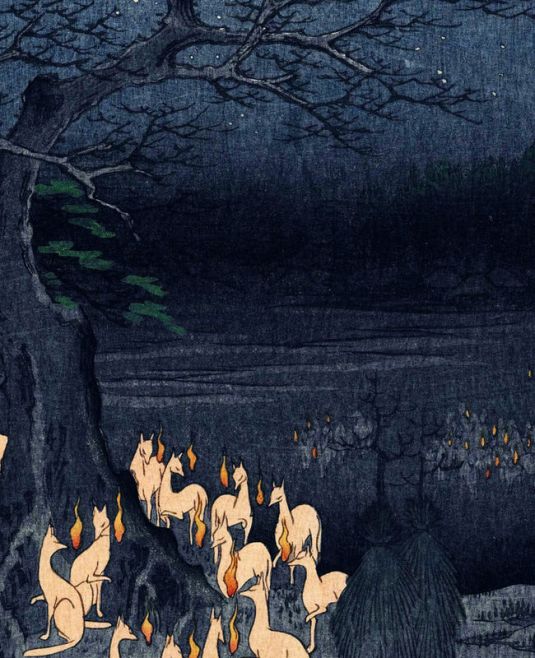
On the rainy night before New Year’s Eve, at around 5pm, a friend and I were hurrying to the station, past Victoria Park, when we glimpsed a weirdly poetic arrangement: just past the brim of my umbrella, a fox with a singularly lush pointed tail; in the middle distance, a silvery fountain streaming opulently, and furthest away, the Shard winked at us in its elvish festive get-up. There are no photos of this fleeting composition. Would the fox have stayed for anything in the pissing rain? Would we? Would any Instagram filter have made up for the failing light? But you’ll just have to take my word for it, it was magical in its own way.
Could have looked something like this: Hiroshige, New Year’s Eve Fox Fires At The Changing Tree, Oji, 1857
So close to the end of the year, I couldn’t help but see this trio as a kind of vision: the fox, the fountain and the Shard- all different and yet complementary- seemed like 3 wishes for the New Year.
The Fox
My friend, a Californian, told me that when she first moved to London and saw a fox, she initially thought she’d that seen a kind of cat with an odd-shaped tail. I laughed, but her comment made me see the fox with fresh eyes- it wasn’t just a mangy, flea-ridden dustbin hunter, but a tiger-coloured creature with a sly walk and an unearthly cry. Resourceful, shabbily elegant and a survivor until something eventually kills it, the fox is a paradox. Its very purpose is survival in uncertain, precarious circumstances. It will go on the hunt in all weathers and eat anything given the opportunity. By night it will scream and bark to assert its investment in territory or a mate. And yet it maintains that sleek, nonchalant boldness coveted by students of style…
The fox is a relevant symbol for the day-to-day aspects of 2016: earning enough to live, working towards a dream, having antennae for opportunities and putting yourself in the right place at the right time. The fox’s imagination is an earthly one; it sniffs out the way to the prize in the current situation, rather than dreaming up a realm of alternative possibilities. If the fox cared to counsel you, it would say ‘the answer is there… in that old contact/ that box under your bed/ the hobby you’ve been meaning to try for ages…but have you bothered looking?’
The Fountain
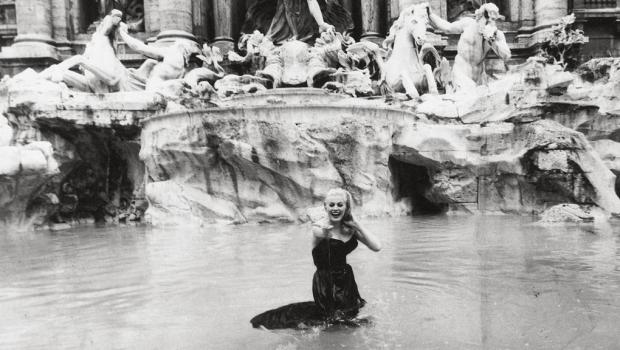
Anita Ekberg in Rome’s Trevi fountain, living, well, what else… La Dolce Vita, 1960
The fountain is life, abundance and the flowing of emotions. I hate that so many New Year’s resolutions are concerned with regimentation and meanness towards oneself or others. We strive to weigh less on the scales, restrict our social contact and give less to those who need it the most. We eat dull food, banish the booze and swap the glitter for grey. This is as close to being dead, while still alive, as it gets. I say that we should go the other way… Not that we should necessarily dissolve our livers in Scotch or buy the sequinned jumpsuit that bankrupts us, but just that we should be generous with our time, energy and resources. Keep giving to charity, go out dancing, share a beautiful meal, a household green initiative or a smutty joke. Above all, recognise that we live in a world of abundant possibilities and that generosity of spirit is rewarded in transparent and mysterious ways.
The Shard
The Shard in its fizzy Christmas spangles. Photo by Marco Uccelini on Flickr
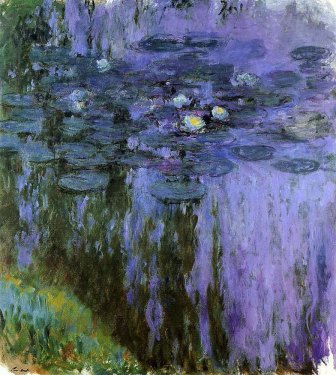
To me, the Shard represents worldly ambition and achievement. Up close it’s a bombastic structure with lucrative views, but at night from a distance, it’s a mystical witness, with one eye to your dreams and heartbreak. I’ve noticed that when it comes to worldly ambition people tend to fall into two camps; those who build their lives around establishing structures and flaunting them, and those who think a life based on worldly acquisition is too bourgeois, restricting or impossible for them. The former risk having a life that’s overly Shard-like, all structure and gloss, but somehow devoid of heartfelt qualities; while the latter, whose lives are effectively written on water, risk depriving themselves from having anything at all. I think it’s okay to have years where you focus more or less on ‘establishing’ goals. 2015 felt like a year when I experienced everything and built nothing. Its overly liquid quality made it one of the best and most frustrating years of my life. This year, however, I’m looking to redress the balance – I’m not going to build another Shard, just plant a few landmarks in my water-garden…
Monet in 1919, knew that the only landmarks worth having were living ones
I don’t steal other people’s books so much as ‘borrow’ them when they haven’t been officially lent to me. A primary instance happened when I was about eleven and my best friend and I were looking for trouble in her attic and found The Joy of Sex, a 1970s sex manual. We opened it up and simply stared. Body parts swelling and merging in ways we couldn’t imagine! And the man had long hair and a beard! This was mystifying in the age of Leo and the Backstreet Boys. We heard footsteps, and quickly stuffed the book back in its place, ensuring that the loose double-pages were folded back in. At that stage, we wanted a peek at knowledge that wasn’t available to us, but weren’t really ready to come to terms with it.
Kind of what happens inside The Joy of Sex. This is actually a clandestine copy of a Valentine in the Paris Opera archive, where I wasn’t allowed to take photographs.
This summer, I was in the makeshift office that had once been my brother’s bedroom and spotted a tomato-red, twenty-fifth-anniversary edition of The Alchemist by Paulo Coehlo. I remembered my brother mentioning it before his motorcycle and bonobo monkey research trip around Africa, and was curious. On the inner leaf was a dedication from an unknown Nik to ‘Mowgli’, his explorer alter-ego:
I wasn’t on the African adventure, but wanted to identify with the ‘true warrior’ who would receive such a dedication, so I slipped the book into my bag. I didn’t feel too bad about it because my brother freely ‘borrows’ my books and returns them in the state of shipwrecked voyagers, with curled pages and half-eroded covers. Besides, he was out of reach, so there was no way to ask him for permission. The Alchemist, a story of a shepherd boy’s trek to Egypt in search of the pyramids and a promised treasure, accompanied me on my own journeys across London for the 5 days it took to read it. In Alan Clarke’s translation, Coehlo’s prose had the spare and sparkling quality of a fairytale, with a touch more sentiment.
Proverbial phrases from the sages the boy meets on his journey, jumped out at me. They seemed relevant beyond the novel’s concise 171 pages and made me feel that its quest was my own. This was Coehlo’s intention for the book and I took the bait. Here’s an assortment of proverbs:
1.‘A blessing ignored becomes a curse…’ How simple, and yet how true. Neglected treasures, whether people, talents or possessions have a way of skulking around, casting great guilty shadows and becoming our enemies. A silk dress left in the closet attracts moths, a beloved who is taken for granted becomes a shrew, and creatives who sideline their practice are notorious drama queens and time-wasters.
2. ‘I know sheep can be friends… I don’t know if the desert can be a friend…’ This could be my favourite of the boy’s musings! It expresses gratitude and tenderness for the friendships he already has, and curiosity about the unknown. Sure, in many ways the arid desert seems the opposite of the shepherd’s fleecy flock; but he’s not about to dismiss it as an enemy out of hand. If more people were this open to difference, there would be less mistrust in the world and fewer wars, seriously.
3. ‘Love never keeps a man from pursuing his personal legend. If he abandons that pursuit, it’s because it wasn’t the love that speaks the language of the world…’ This comes up when the boy considers relinquishing his quest for treasure upon meeting Fatima, his heart’s desire, in an oasis. The statement advocates a world picture based on abundance and trust rather than scarcity and fear. It’s idealised, but I admire its generosity.
This fish’s personal legend was clearly to jump out of the water and dive into a book…
As much as The Alchemist paved its way into my thoughts, at times its gender bias reminded me that I had stolen the book from my brother. The male nameless shepherd’s personal legend is journey towards the treasure; whereas his Intended, Fatima’s personal legend is him. Fatima is given some of the most beautiful and moving lines in the book:
‘I’m a desert woman, and I’m proud of that. I want my husband to wander as free as the wind that shapes the dunes. And, if I have to, I will accept the fact that he has become a part of the clouds, and the animals, and the water of the desert…’
Her words are noble because they describe love as gift to be open to, but not as an entity that can be possessed and controlled. And yet, there is something limiting (Penelope-like) about her destiny as an eternally receptive vessel with no journey of her own. Doesn’t she want to wander too, have a personal quest that can coexist with her love, not be wholly informed by it? But there I go, imagining fairytale endings for a story that’s not mine…
Universal journey or Boys’ Own adventure?
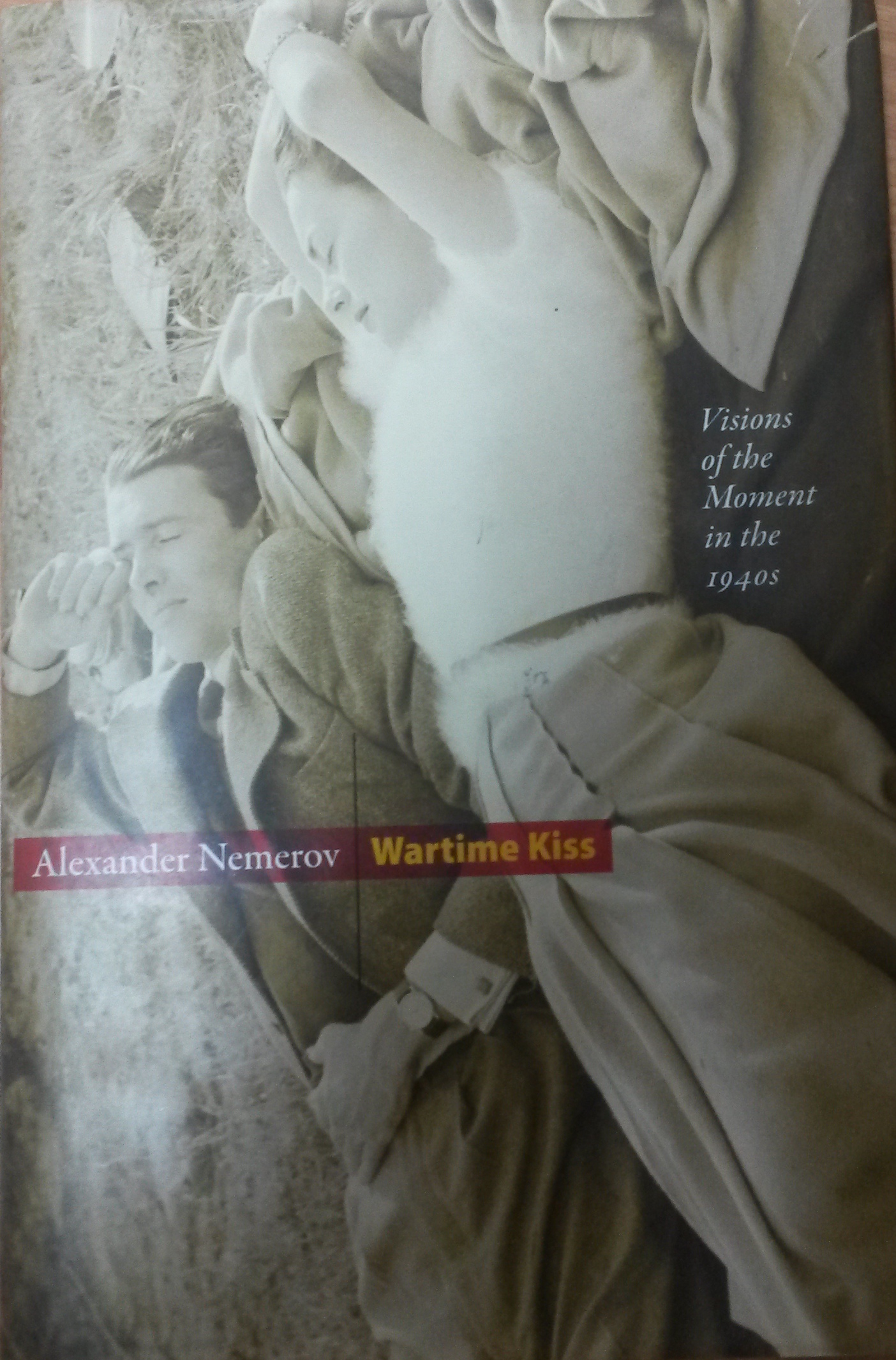
Some borrowings require more tact and subtlety. Every Thursday I sit in my supervisor’s office for an hour, when students can come and ask questions about the course. They rarely do. So I sit on her spinning chair and scan shelf upon shelf of books. Some are gleaming and expensive, with the aura of gifts; others are tiny, rare and cloth-bound; these, I imagine, have been carefully sourced. Intriguingly specific studies of now-forgotten designers are juxtaposed with sentimental titles like Wartime Kiss and generic volumes from grand theorists. The books have been thematically arranged and delicately handled. Apart from the odd volume placed askew, perhaps as a reference point, they appear as untouched as Snow White under rock crystal. When I take one to pass the hour, because after all, no one said I shouldn’t, I’m careful not to touch the book too much, change its shape, or God forbid, break its spine, and replace it with the exactitude of evidence in a murder scene. In this space, bibliophilia means something different from my own cavalier love for my travelling volumes. As a thief of sorts, I must be respectful, or get caught.
Immaculate book, crystalline pages
Poaching books is a way of crossing each other’s boundaries. We do it because we’re curious and want to be close, perhaps as a way of identifying with someone, or gaining some sort of subtle knowledge about them, or for ourselves. It could be seen as a creepy act, because no-one has given you direct permission; but, done respectfully, it can also be an empathetic gesture. Perhaps a person’s books, like their actions and body language, are indirect or surrounding manifestations of their character and dreams, beyond the words they choose to speak. To adopt Coehlo’s theme, these unspoken signals form part of ‘the language of the world.’
Reading List
Alex Comfort, The Joy of Sex (London: Quartet Books, 1974). *
Paulo Coehlo, The Alchemist: 25th Anniversary Edition, trans. Alan Clarke (New York: Harper Collins, 2014).
Alexander Nemerov, Wartime Kiss (Princeton: Princeton University Press, 2012).
*I can’t remember which edition we found in the attic, but this is the original.
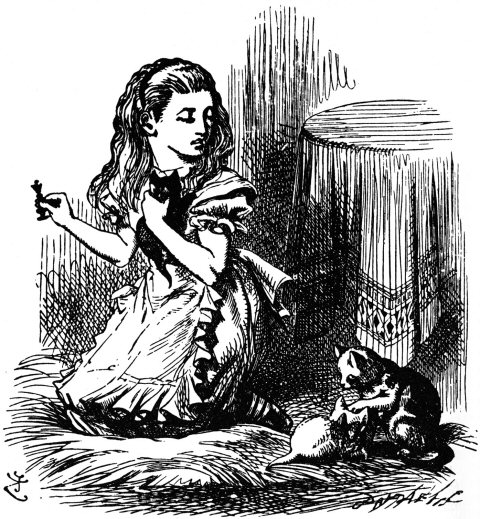
‘Now, Kitty, let’s consider who it was that dreamed it all. This is a serious question, my dear, and you should not go on licking your paw like that— as if Dinah hadn’t washed you this morning! You see, Kitty, it must have been either me or the Red King. He was part of my dream, of course— but then I was part of his dream, too! Was it the Red King, Kitty? Text: Louis Carroll. Illustration: John Tenniel
When Alice wakes up from her dream at the end of Through the Looking Glass, she wonders whether the Red King was part of her dream, or whether she was part of his. I’ve often felt that way about memory. I’m never sure whether a memory is truly mine, or part of some collective consciousness. Some good memories, especially, feel like they belong to a universal wish list.
Holiday decorations are memories materialised. The hanging pair of silver skates I bought on December 1 this year, are souvenirs of skating on a frozen pond, one Christmas long, long ago. But whose memory is it? And is it a memory at all, or some collective Winter fantasy? My favourite skating memory didn’t involve skates at all, but was a spontaneous glide in my boots, across a frozen stream in Potsdam on New Year’s Day, while my 6’7 friend threatened to crack the ice.
Magical, what skating should be.
But I’d recently seen a black and white film of fleet-footed ice skaters c.1900, carving mesmerising figures of eight, across rinks fringed with firs. The slender, silvery decorations, sourced among the foliage of a Primrose Hill florist, reminded me of the celluloid ice rink’s sparkle and the fluid delicacy of its skaters. I bought into it, this memory that was half mine. It seemed authentic and hopeful.
As for my own precious memories, a lot of them are shared with others. One of them might be on loan from my mother. I remember watching TheGreat Gatsby in my English class, aged 15. There was the scene of Gatsby’s party, and then this Charleston music started, with lyrics that went something like ‘Yes Sir, that’s my baby, No sir…’ I’ve danced to that, I suddenly thought- in my great grandma’s lounge, when I was about 5, and I think there was a ginger cat there, too. Dancing to my great grandma’s piano playing is one of my happiest childhood memories, and every time I revisit it, something appears differently. Realistically, I don’t think I could have danced the Charleston, because where would I have learnt it? At 5, my favourite dances were the twirls and leaps I copied from cartoon princesses and their animals, or simply spinning until I got so dizzy, that I fell on the floor.
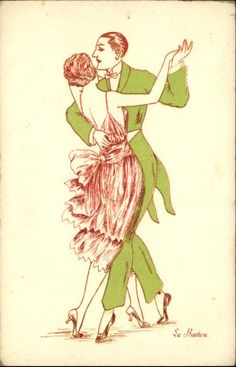
What dance feels like, when you’re 5.
My mother always used to tell me that she danced the real Charleston in my great grandma’s lounge though, with her dad, who taught her the steps. He was a good dancer, and I adored him up until the age of three, when he died, and I immediately forgot him. To this day, I can’t picture him, though I sometimes dream about him. Mum says that my great grandma did play the piano for me, but she can’t be sure about the Charleston, and there was no ginger cat. I think I stole him from Breakfast at Tiffany’s.
What dance looks like, when you’re 5. ‘Snow White and The Seven Dwarves,’ Disney.
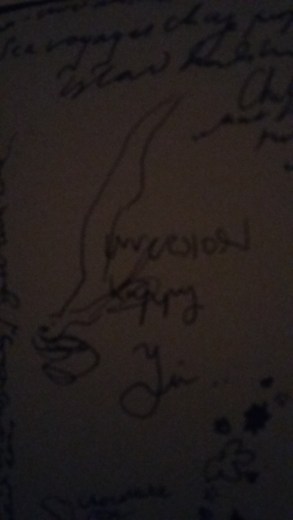
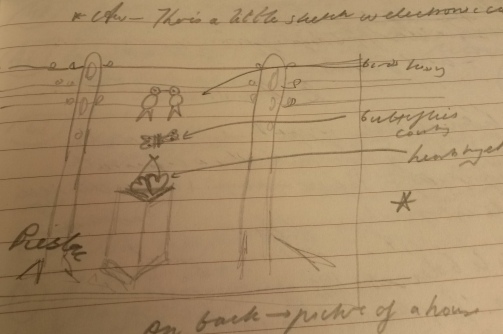
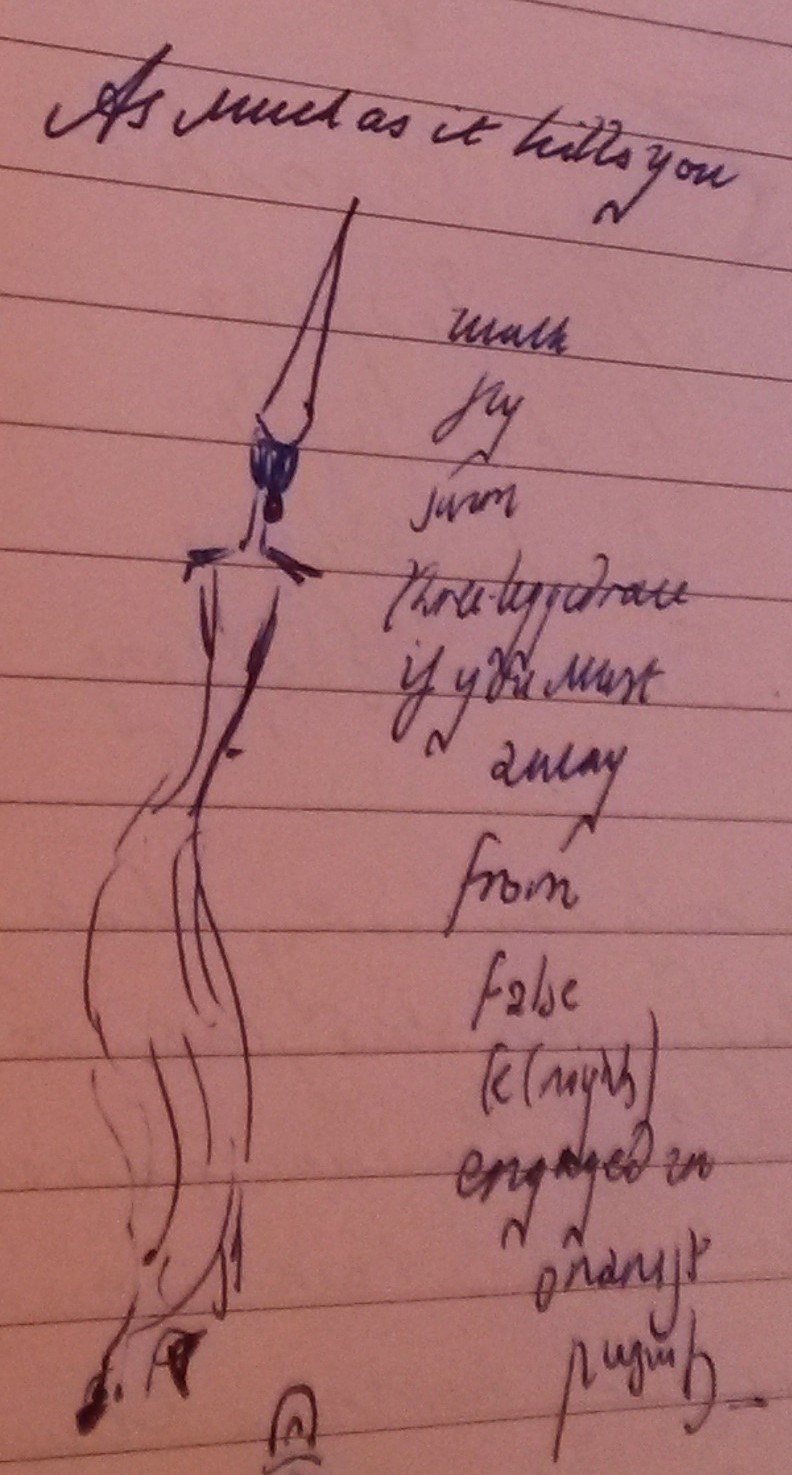
And then, in an old, undated, journal, I came across something from a day I can’t remember. There’s this sketch of a girl, armless like the Venus di Milo, in a cone hat and long flowing gown, escaping from something. The barely legible caption beside her reads ‘as much as it kills you walk, fly, three-legged-race if you must, away from false (k)nights engaged in onanist (sic) pursuits.’ On the diary page, she’s between another girl in a cone hat, warning her not to be a Damsel in Distress, and a picture of two guys with what appear to be light bulbs on their heads. One wears glasses, the other does not. Neither looks especially predatory.
When you’re that impassioned, arms are unnecessary.
I think the girl represents me- a sublimated alter ego in Medieval princess garb, but I really can’t identify my two male tormentors, I don’t know what caused me caused me to draft this little scenario, but the brackets around k in (k)nights indicates a pun: I could have been angry at being slighted and deceived by a guy I was now accusing of self-pleasuring, and worried that I myself was pining away in nights of lonely fantasy. My urgent need to escape, though indicates that I might have received unwanted attention. The possibilities are endless, because I can’t remember what led to this hurried, hysterical sketch, which seems more fairy tale than fact.
The word onanist, by the way (a noun, used incorrectly as an adjective), shouldn’t be taken too literally. I had probably just come across it, and was trying it out as a more damning, dramatic version of ‘daydreamer.’As for the medieval get-up, I can only say that I have always liked cone hats, and found it easier to mediate my feelings through fantasy. Weirdly enough, the one thing I can vaguely remember, is sketching the princess, and consciously deciding to leave her unembellished, so she could look like anyone.



















 andthepea